
What is a Language Representation and Vectorisation Technique?
Language representation and vectorization techniques are two important pillars of Natural Language Processing (NLP). The development of these techniques is a crucial step towards how computers can understand and use human language. Here we will try to discuss in depth the fundamentals of these concepts, their importance and applications.
Language Representation
Language representation refers to converting words, sentences, or text of a natural language (human language) into a structure that a computer can understand. Its main purpose is to capture aspects of language that make human communication special. This technique ensures that computers not only recognise words, but also understand their meaning, emotions, and context.
Following are some important points of language representation:
Understanding context: The context of language can affect the meaning of words. For example, the word “bank” can mean a financial institution or a riverbank, depending on the context. Language representation ensures that the computer can understand this context.
Grammar and structure: Language is not just a group of words; it is a structure that includes grammar and rules. Effective language representation takes these elements into account as well, so that the correct meaning of sentences can be derived.
Contribution to machine learning: When words and sentences are presented in an organised form, machine learning models are able to understand them and give accurate results. For example, when you ask a chatbot a question, it needs the correct language representation to answer it.
Vectorization Techniques
Vectorization techniques are the processes of converting words and sentences into numerical form. Its main purpose is to represent language data in a form that machines can easily understand and process. This technique is especially important in machine learning and deep learning.
Following are some of the main aspects of vectorization:
Numerical representation: During the vectorization process, each word or sentence is converted into a vector (list of numbers). This vector represents various properties, such as the meaning of the word, its context, and its relationship with other words.
Determining similarity and dissimilarity: In vector space, vectors of words with similar meanings are adjacent to each other. In this way, machines can understand the similarity and dissimilarity between words. This is especially helpful in clustering, classification, and other machine learning tasks.
Supporting machine learning models: Without vectorization, machine learning models may find it difficult to analyze language data correctly. By using data in vector form, these models can work more accurately and effectively.
Applications
Language representation and vectorization techniques are used in various fields. These include:
Search engines: When you search for a term, search engines use language representation and vectorization to understand the meaning of your query and show relevant results.
Sentiment analysis: Companies use these techniques to understand customer sentiments towards their products and services. This helps them improve their marketing strategies.
Chatbots and virtual assistants: These systems use language representation and vectorization techniques to answer users’ queries accurately.
Translation systems: In machine translation, these techniques are helpful in translating from one language to another with the correct meaning and context.
Different Types of Language Representatins
As mentioned above, Language Representation means converting words, sentences, and text of a language into a format that a computer can understand. This process is extremely important for Natural Language Processing (NLP), as it helps computers understand the meaning and context of human language. There are different types of language representation that play a vital role in NLP. Some of these are:
1. BOW (Bag-of-Words)
BOW representation is a simple and commonly used technique. In this, the sentence or document is viewed as a set of words, where the order of the words is ignored. The presence or absence of each word is represented as 0 and 1.
Example: If we look at the sentence “cat is eating mouse”, in BoW representation we will only see which words are present, such as “cat”, “is”, “mouse”, “eating”.
2. TF-IDF (Term Frequency-Inverse Document Frequency)
TF-IDF is a more advanced technique used to measure the importance of a term in a document.
- Term Frequency (TF): The frequency of occurrence of a term in a document.
- Inverse Document Frequency (IDF): It shows how common that term is in a set of documents.
Example: If the term “cat” occurs frequently in a particular document but less frequently in the entire set, it will have a high TF-IDF score.
3. N-gram Representation
N-gram representation is used to understand the order of words. In this, a sentence is divided into small groups of words (n-grams). For example, in 2-gram (bigram), the sentence “cat is eating mouse” will be divided into groups like “cat is”, “is eating”, “eating mouse”.
4. Sentence-Level Representation
This technique is used to understand the meaning of a sentence and the relationships within it. In this, sentences are arranged in their context so that machines can better understand what the sentence means.
Example: This technique is important in conversational AI, where it is necessary to understand sentences in the right context.
5. Neural Network-based Representation
Neural networks, specifically recurrent neural networks (RNNs) and convolutional neural networks (CNNs), are used for language representation. These networks can process words in the context of time and space, making it possible to understand order and structure.
6. Transformer-based representations
Transformer models, such as BERT (Bidirectional Encoder Representations from Transformers) and GPT (Generative Pre-trained Transformer), are highly effective for language representation. These models are able to understand words by taking their context into account.
What is an Embedding?
Embedding in NLP refers to a technique in which words, phrases, or even entire sentences are represented as numerical vectors in a continuous vector space. This representation captures the semantic meaning and the relationships between different words or phrases, helping algorithms understand text data and work on it effectively.
Here are some key points of embeddings:
-
Dimension reduction: Embeddings reduce the high-dimensional space of words (such as a large dictionary) into a lower-dimensional space, making calculations more efficient.
-
Semantic relationships: The position of words in this vector space reflects their meanings and relationships. For example, similar words are often close to each other in this space.
-
Common techniques:
-
- Word2Vec: Trains to predict a word using the context of words or to give a word context.
- GloVe (Global Vector for Word Representation): Generates embeddings using co-occurrence statistics of words.
- FastText: Extends Word2Vec and considers subword information, allowing it to generate embeddings for unknown words.
- Sentence and document embeddings: Techniques such as Universal Sentence Encoder or BERT provide embeddings for larger text units, which capture more context.
Embeddings are used in various NLP tasks, such as sentiment analysis, machine translation, and information retrieval, as they help models generalize better from limited data.
Differece between Word2Vec, BERT and GPT approaches
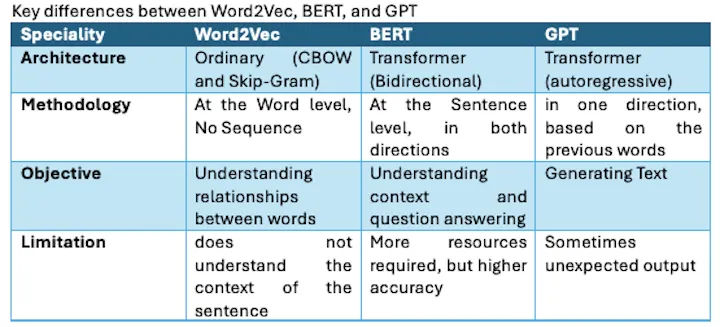
In Natural Language Processing (NLP), several techniques have been developed for the representation of words and sentences. Prominent among them are Word2Vec, BERT, and GPT. All these models help in understanding the meaning and context of words, but there are significant differences in their methodology, structure, and usage. In this article, we will explain the distinction between these three techniques.
1. Word2Vec
Word2Vec is a simple and effective word embedding technique developed by Google. This technique mainly works in two architectures: Continuous Bag of Words (CBOW) and Skip-Gram.
Methodology:
CBOW: It predicts the focused word using the surrounding words. For example, for the word “rat” words like “cat” and “eat” are used.
Skip-Gram: On the contrary, it predicts the focused word using its surrounding words.
Limitations: Word2Vec only works at the word level and it does not understand the order of words and the context of the sentence. It does not capture the relationship between words in a certain sentence.
2. BERT (Biderectional Encode Representations from Transformers)
BERT is an advanced model, developed by Google. It is a transformer-based model that is able to understand words in their context.
Methodology: BERT reads words in both directions (left to right and right to left), which makes it understand the context of the sentence better. It uses Masked Language Modeling, in which certain words are masked and the model is trained to predict them.
Advantages: BERT is able to understand context at the sentence level, which makes it deliver better performance. It achieves high accuracy in various NLP tasks, such as question answering, sentiment analysis, and more.
3. GPT (Generative Pre-trained Transformer)
GPT (Generative Pre-trained Transformer) is another transformer-based model, developed by OpenAI. It mainly focuses on generative tasks.
Methodology: GPT is an autoregressive model, which means it predicts one word at a time, based on previous words. It is pre-trained on massive amounts of data and can then be fine-tuned for particular tasks.
Advantages: The specialty of GPT is that it is able to generate text with human-like creativity. It can be used for a variety of tasks, such as story writing, dialogue generation, and others.
The evolution of language representation techniques is an interesting journey to understanding language. We started with the Bag-of-Words model, which was based on counting words, and now we have reached methods that understand semantic meaning and context. Word2Vec introduced a new way of embedding, which made it easier to understand the relationship between words. Then came BERT, which helped understand language by taking context into account. Finally, models like GPT, which use generative pre-training, have opened up even newer avenues.
With all these techniques, we are trying to build models that not only understand words, but also recognize the complexities of human conversation. As we continue to work on these, new and exciting possibilities will emerge in the world of AI and language.