The Arrival
I arrived at Trang An just as the first light began to stretch over the limestone cliffs.
The mist lingered low over the river, curling around rocks and reeds like a soft white ribbon. Everything felt paused, suspended between night and day. Boats rested gently along the bank, their wooden hulls polished smooth by years of gliding through the water.
No one spoke. No engines hummed. Even the air seemed to hold its breath.
I stepped onto one of the boats. The woman guiding it nodded, her conical hat casting a shadow over her face. The river accepted us without effort, carrying the boat forward as though it had been waiting for this moment for centuries.
In that quiet, I realized: Trang An does not announce itself. It waits.
The River Speaks
The river spoke in the subtlest of ways.
Each gentle ripple against the boat whispered secrets of time. Streaks of sunlight broke through the mist, landing on the water like scattered gold coins. Reflections of cliffs and trees shimmered, dancing lightly with each stroke of the oar.
I tilted my head, listening.
No one else was around, yet the world seemed alive with presence. Somewhere deep in the limestone, the river carried centuries of rain, stories of travellers, whispers of ancestors. I felt as if I were gliding over history itself, moving silently through a memory written in water.
It was impossible to rush here. The river set its own pace. And slowly, I began to follow.
The Cave That Breathes
We approached the first cave, a low, shadowed mouth in the cliff.
A cool current greeted us as we entered, brushing my face like an exhale. The ceiling hung close, stalactites reaching down like frozen fingers. Water dripped with a patient rhythm.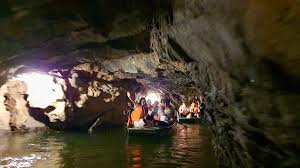
“This cave breathes,” my guide whispered. “When water rises, it exhales. When water falls, it inhales.”
I felt it then, the pulse of air, subtle yet alive. The cave had witnessed kings fleeing invaders, families hiding in shadows, and travellers like me. Yet it made no demand of those who passed through. It simply existed, enduring, breathing, keeping time without speaking.
When we emerged, the sunlight felt new, almost fragile, spilling across the river in warm, golden fragments.
A Temple in the Rocks
Further along the river, a small temple appeared, carved into the cliff.
The wooden beams were weathered, the floor worn smooth by countless footsteps. Inside, incense smoke curled lazily toward the ceiling. A single altar held a few offerings, faded flowers, incense sticks, small bowls of water.
No crowds, no ceremonies. Just presence.
I stood for a long while, listening, not to words, but to the space itself. The mountain leaned over the temple, holding it gently, like a guardian. Time felt slower here. Even the river seemed to wait, honouring the quiet.
Lotus Shadows
The river widened, and suddenly green fields of lotus leaves appeared, stretching across the surface.
Pink flowers rose above the water like delicate sentinels. Their scent was soft and almost ethereal, carried lightly by the breeze. Women waded carefully through the shallow water, harvesting flowers and seeds with patient precision. Their movements were rhythmic, almost ceremonial, each gesture a quiet story of care and life.
Every part of the lotus was used, leaves, flowers, seeds, stems. Nothing wasted. Nothing rushed.
It was a lesson the river seemed to teach effortlessly: beauty grows slowly, patience yields reward, and the smallest acts can be profound.
Children of the River
Along the bank, children ran barefoot through the shallow water, laughing as their small boats swayed gently.
A boy balanced on the edge of a wooden hull, wobbling, arms outstretched, before tumbling into the cool river with a splash. His laughter echoed across the valley, pure and untamed.
It struck me that these children were born into the rhythm of the river. They understood its currents instinctively, moved with its tides, and learned lessons that no school could teach.
Here, life flowed differently. Not faster or slower, but aligned. They were part of something larger, a living story that had been unfolding for centuries.
The Old Woman’s Tea
At a small wooden dock, an elderly woman waited with a steaming pot of lotus tea. Her silver hair shone faintly in the soft sunlight.
We sat on low stools, hands wrapped around warm cups. She spoke little, only offering smiles and nods, but the silence between words was rich, full of meaning.
“This river gives life,” she said finally. “It feeds, it protects, and it teaches. We must respect it.”
I realized then that respect here was not a rule. It was a way of living, woven into daily life like threads in a tapestry. The river, the mountains, the people, they were all connected, and to honour one was to honour all.
Even without understanding every word, I felt the truth in her gesture, in the way the steam rose slowly from the cup and dissolved into the morning light.
Shadows of Kings
Somewhere deep in the cliffs, hidden from the casual eye, were caves that once served as secret refuges for kings and warriors.
I imagined them moving silently through narrow passages, guided by locals who knew every bend of the water and every stone along the cliffs. Battles had been fought here, plans whispered in darkness, yet the river remained indifferent, carrying the stories forward without judgment.
Standing on the edge of one hidden inlet, I felt the weight of history pressing gently against the present.
Trang An was not just a landscape of beauty, it was a keeper of memory, a witness to human ambition and fragility alike.
The Dragon Stalactite
Inside a narrow cave, a formation hung from the ceiling, twisted and jagged. My guide pointed at it.
“Dragon,” she said simply.
I tilted my head. The shape was unmistakable, a head, a mouth frozen mid-roar, a long spine curling above the water.
Some said it was luck, some said protection. I didn’t need the words. The moment itself carried meaning.
It reminded me that stories can exist quietly in nature, shaped not by humans but by time and patience. And that sometimes, seeing is understanding.
Evening Light Over the Water
As the sun sank toward the horizon, the river transformed again.
Shadows stretched across the water, cliffs turned amber, and lotus flowers glowed as if lit from within. The air smelled faintly of wet earth, incense from the distant temple, and the faint sweetness of lotus petals.
Boats drifted silently, moving through the golden light, carrying people who lived in harmony with the rhythm of water and stone.
I watched for a long time, realizing that the beauty of Trang An was not in grand gestures or dramatic views. It was in every small, patient detail: the slow arc of an oar, the careful balance of a child on a boat, the gentle rise of a lotus flower above the water.
It was a lesson in observation, humility, and wonder.
The Hidden Shrine
Along a narrow inlet, nestled between jagged cliffs, I spotted a tiny shrine I had never noticed before.
It was carved directly into the limestone, no bigger than a doorway, yet radiating presence. Faded red paint outlined a small Buddha, and incense sticks burned quietly in the humid air.
I knelt for a moment, not to pray, but to acknowledge the space.
Even the smallest offerings here felt significant. They were reminders that humans and nature share a language of respect, a quiet dialogue written in stone, smoke, and water.
Mist on the Limestone
The river narrowed again, cliffs pressing close on either side. Mist clung stubbornly to the rocks, drifting slowly down the river like a veil.
Every detail became magnified, the veins of moss on stone, a solitary bird perched above, the ripple of water around the boat.
I realized that Trang An reveals itself in layers, one subtle movement at a time. Miss one, and the magic slips away.
Even as I watched, I felt the river’s patience: there is no rush here, and nothing truly waits.
The Fisherman’s Routine
A man sat knee-deep in the water, repairing a fishing net. Each knot was precise, deliberate, as though the rhythm of his hands echoed the pulse of the river itself.
He did not glance up as we passed, but I felt his awareness. He knew the river, the tides, the way the water would carry food and life each day.
I thought of how often humans ignore patience, chasing results instead of learning rhythm.
Here, rhythm was life itself.
The Sound of Dripping Water
Another cave opened ahead, low and narrow.
Inside, water dripped from stalactites, each drop falling with perfect timing, echoing faintly against the walls. I counted the rhythm, drip… drip… drip.
It was hypnotic. And suddenly, I understood: these caves have a tempo of their own, slow but unstoppable.
Time here is measured not in hours, but in stones, water, and echoes.
I closed my eyes and let it teach me.
The Lotus Field at Dusk
We emerged again into open water, and the river widened into a basin full of lotus.
The petals glowed pink in the soft light of dusk. Leaves spread across the surface like floating shields, each one unique, each one perfect in its imperfection.
Women continued to harvest the flowers, moving with quiet skill. Their movements felt like part of the natural flow, not separate from it.
I noticed the way a child reached for a flower and watched it tremble before settling back onto the leaf.
Even small lives here were attuned to the water, the stone, the sky.
The Echo of Ancient Kings
In one narrow canyon, the cliffs rose like silent sentinels. I imagined warriors of centuries past moving stealthily through hidden passages, guided only by knowledge of the river and the caves.
These waterways were more than paths, they were lifelines. Kings and soldiers had once hidden here, whispering plans in shadows, relying on the stone and water to conceal them.
Even now, the echoes lingered. I could almost hear the soft clatter of sandals against rock, the faint murmur of voices, the steady pulse of human lives entwined with the river.
Trang An is not only natural beauty, it is history carved into every curve of limestone.
The Bamboo Grove
Along the bank, a bamboo grove swayed in a gentle breeze. The tall stalks bent slightly, creating a quiet rustling that blended with the river’s soft lap.
I stepped onto the shore briefly. The soil smelled sweet and earthy. Sunlight filtered through the leaves, painting the ground with shifting patterns of gold and green.
It was a reminder that even in the presence of stone and water, life insists on softness. Bamboo bends, yet it does not break. It thrives because it moves with the current, not against it.
I carried that image with me as we pushed off again, grace thriving alongside resilience.
The Fisherman’s Story
Further down the river, an older fisherman guided his small wooden boat through shallow water. Nets dangling, he hummed a melody I couldn’t name.
I asked my guide about him. She said he had fished this river for decades, learning every eddy, every hidden channel, every secret beneath the surface.
“Some rivers give generously,” she said, “but only to those who understand them.”
I watched the man work, slow and deliberate. Patience was more than habit here, it was survival. And I understood then that knowledge of Trang An was not found in books or cameras. It was found in rhythm.
The Cave of Silence
We approached another cave, wider and darker than the rest.
Inside, the world changed completely. Light faded, sound diminished, and the air felt heavier with centuries of history. I floated forward in the boat, listening to the drip of water, the faint stirrings of unseen creatures, and my own heartbeat.
Silence became tactile. It pressed gently against my skin, filled the spaces between thought, and held me.
When I emerged again, the sunlight seemed sharper, almost startling. I realized that Trang An is built on contrasts—light and dark, calm and tension, presence and absence.
The Reflection of Life
Back in open water, I noticed my own reflection on the river’s surface.
Mountains, sky, and water mirrored each other perfectly. For a moment, I could not tell where I ended and the river began.
It was a quiet lesson: in Trang An, humans are small but inseparable from the landscape. Our lives are brief, our influence subtle, but the rhythm of the world continues whether we observe or not.
It reminded me to move slowly, to notice carefully, to be present.
The Lotus Harvest
At dawn, we arrived at a quiet field of lotus stretching across the river.
Women in simple conical hats moved carefully through the shallow water, plucking blossoms with gentle, practiced hands. Each flower was handled as if it held a secret, placed in baskets lined with leaves to protect its delicate petals.
I watched a young girl pause to admire a fully opened pink bloom before tucking it into her basket. Her smile was small, fleeting, but I felt the weight of the moment: life’s beauty thrives in attention.
The river mirrored their movements, rippling softly beneath them, as if applauding their care.
Evening over the River
The day began to fade, and a warm golden glow spread across the limestone cliffs.
Boats drifted slowly along the water, their silhouettes framed by light and shadow. The river itself seemed to exhale, slowing its current, as if preparing the world for night.
I leaned back in the boat and let the silence envelop me. The only sound was the gentle slap of water against wood, mingling with the distant call of birds returning to roost.
Evening in Trang An felt like a slow, deliberate sigh, a pause that allowed everything to exist fully before the world went dark.
Children in the Mist
A group of children appeared through the low-hanging mist, chasing one another along the water’s edge.
Their laughter was bright, echoing faintly between cliffs. Some jumped into shallow pools, splashing and shrieking with joy.
Watching them, I realized how naturally they belonged here, they were children of the river, learning its rhythms before they could even name them.
The moment felt complete: life, water, and stone intertwined in perfect harmony, a single heartbeat shared by all who lived here.
The Temple Incense
As darkness settled, the small temple on the cliff glowed with faint orange light from burning incense.
The smoke curled upward, twisting through the evening air. I could see shadows of the mountains reflected on the water, merging with the drifting smoke.
I stepped onto the temple landing, breathed in deeply, and felt a sense of continuity: generations of worshippers, travelers, and villagers had paused here, leaving traces in scent, light, and memory.
It was a quiet reminder that some connections are invisible yet profoundly present.
Stars Above the Limestone
Night fell fully, and the cliffs became dark silhouettes against a sky heavy with stars.
The river reflected them perfectly, doubling the constellations in a mirror of black and silver. Every ripple, every subtle wave, seemed to carry light as if the stars themselves had agreed to float on the water.
I realized then that Trang An is a place where time folds: day into night, water into sky, life into memory.
Even when humans leave, the river, the stone, and the lotus remain, continuing the story silently.
The Forgotten Passage
We approached a narrow, almost hidden channel that few travelers seemed to notice.
The walls leaned close on either side, covered in moss and streaked with mineral veins. Water lapped quietly at the edges, and the only sound was the gentle creak of the boat.
My guide leaned forward, gesturing to the passage. “Few enter here. It remembers those who do.”
I felt the weight of that statement. The river here was not just a path; it was a keeper of memory. Every curve, every drop, every echo in the cave carried centuries of stories.
As we slipped through, I understood that some places exist to remind us that not all histories are visible at first glance.
The Echoing Chamber
Inside the cave, the world contracted.
Drips of water fell from the ceiling, each one echoing, multiplying, then fading into nothing. It was as if the cave itself had a heartbeat, slow and measured.
I spoke quietly, and my words bounced back at me distorted, softened, and strange. For a moment, I felt as if I were conversing with the stone itself.
The echo was more than sound. It was presence. It reminded me that every corner of Trang An, no matter how hidden, carries life and memory.
The Lotus Seed Collector
At a shallow bend, an old woman collected lotus seeds with gentle patience.
Each pod was examined carefully, plucked, and dropped into a basket lined with leaves. Her hands moved slowly, deliberately, as though she were performing a ritual rather than labor.
I watched for a long time, realizing that this small, repetitive act was a meditation. In Trang An, even the most ordinary work could become sacred if done with awareness.
The river reflected her image perfectly, showing a double world where action and reflection existed simultaneously.
The Hidden Shrine in the Cliffs
We stopped at a small recess carved into the limestone, almost invisible from the river.
Inside, incense smoke drifted lazily, and a tiny statue of Buddha looked out over the water. There were no crowds, no ceremonies, only the quiet presence of devotion through time.
I felt the centuries fold in that moment the pilgrims, travellers, and locals who had paused here, leaving traces of reverence in the smoke, in the carved stone, and in the air itself.
Trang An teaches that some things cannot be rushed. Some lessons arrive only to those who wait.
The Moon on the Water
Night had fallen fully, and a pale moon rose slowly over the cliffs.
Its reflection spread across the river like liquid silver, turning the water into a mirror of sky. Each ripple fractured the light, creating tiny glimmers that danced along the hull of the boat.
I realized that Trang An is a place where time folds and layers: day into night, water into sky, the living into memory.
Even alone, I felt accompanied by everything that had come before: the river, the stone, the lotus, the people. All of it moving together in a rhythm older than comprehension.
Dawn Over Hidden Paths
The first light of dawn crept over the cliffs, painting the limestone with soft gold and pale rose.
Mist curled along the river like drifting silk. The caves we had passed yesterday seemed transformed, their mouths gentle and inviting in the new light.
I stepped into the boat again. The oars moved almost on their own, as though the river remembered the rhythm of yesterday.
Everything felt possible in this quiet morning: discovery, reflection, and the understanding that the river does not hurry, it waits for those who notice.
Lotus Petals in the Sunlight
The lotus fields shimmered in the early sun, each petal delicate and perfect, glistening with dew.
A bird landed on a leaf, startled me with its sudden call, and then flew away. The movement seemed insignificant yet complete, like a note in a symphony.
I realized that beauty here is not grand or shouted. It exists in small, persistent details, in moments repeated over centuries.
The river mirrored the sky, the cliffs, and the lotus, creating a world that was doubled, but somehow more real.
The Last Cave
We drifted toward the final cave of the journey, narrow, deep, and still untouched by sunlight.
Inside, the water was dark, the ceiling low. Drops fell silently from the stalactites, echoing faintly, one by one.
I closed my eyes and listened.
For the first time, I understood: Trang An is not only a place you see—it is a place you hear, feel, and remember. Every drip, every whisper of the river, every breath of air carries centuries of life.
And I, for one, was becoming part of that memory.
The Temple at Noon
At a small temple tucked high against the cliff, incense rose in gentle spirals.
The monks and villagers moved quietly, each gesture deliberate, each action small yet meaningful. I watched from below, absorbing their stillness, realizing that reverence is not about grandeur, it is about attention, care, and presence.
The temple, like the caves and the river, existed not for spectacle but for those willing to notice its quiet grace.
Reflections on the River
Back on the water, I looked into the river’s mirror.
Mountains, sky, clouds, lotus flowers all reflected perfectly, doubling reality yet making it feel somehow more profound.
I thought about the people I had seen: children, fishermen, lotus harvesters, monks. Each life was small in the scale of the river, yet perfectly aligned with it.
Trang An had taught me that harmony does not mean control. It means moving with the rhythm of life rather than against it.
The Farewell
The boat reached the pier where I had first arrived.
I stepped onto the dock slowly, letting the wood creak beneath my feet. The cliffs rose around me, timeless and indifferent, yet I no longer felt small. I felt included.
I looked back at the river. It glistened in the afternoon sun, still, calm, and eternal. I knew I could leave Trang An physically, but it would remain with me forever in memory, in rhythm, in every quiet corner of my mind.
Some places do not end. They linger, waiting for the next visitor, the next story.
Closing Reflection
Trang An is more than limestone cliffs and flowing rivers. It is a lesson in patience, presence, and observation.
It reminds us that time is layered: past and present intertwine in caves, temples, and lotus fields. Beauty is patient, history is quiet, and every detail matters.
As I walked away, the mountains seemed to nod, the river shimmered, and the lotus glowed faintly.
And I understood, finally, that some journeys never truly end, they live on in those who notice.