This was my first trip to China. I went Beijing, then Xi'an, then Chongqing, then Yangshuo. After Yangshuo I kept going, to Shenzhen and then Guangzhou. So Yangshuo was not the end of the trip. It was somewhere in the middle. But it turned out to be one of the best parts of the whole thing, and I did not plan for that at all.
Before I went, I could not find much about Yangshuo online. A few photos, a few short blog posts, not much real detail. That actually made it better. I went in without knowing what to expect, and it became one of those offbeat, unplanned places that end up staying with you more than the famous ones. If you have been to Ninh Binh in Vietnam, it reminded me a bit of that. Same kind of feeling quiet, green, a little hard to find good information on, but worth every bit of the trouble.
Why Yangshuo Looks Like That
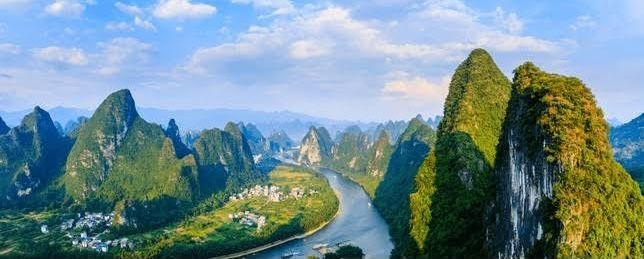
Before I get into what I actually did there, it is worth explaining why the place looks the way it does, because the landscape is really the whole reason people go. Those tall, narrow peaks around Yangshuo are called karst mountains, and they are not hills that wore down from something bigger. It is the opposite. Around 300 million years ago, this whole area was under a shallow sea, and layer after layer of limestone built up on the seabed over millions of years. Later, when the Indian subcontinent crashed into Asia and pushed up the Himalayas, the same forces lifted this old seabed up out of the water. After that, rain did the rest of the work. Southern China gets heavy, slightly acidic rainfall, and over a very long time it dissolved the softer limestone along cracks and weak points, carving out caves and channels while the harder rock stood firm and got left behind as these tall, separate towers. Geologists have a name for this specific pattern, fenglin or "peak forest" karst and Yangshuo sits at the point where this style of karst is at its most extreme, which is part of why the scenery here shows up in old Chinese paintings so often.
Yangshuo itself is an old place, not just a scenic backdrop. As a county, it goes back more than 1,400 years, to around the Sui Dynasty. For most of that history it was a farming town, quiet and mostly unknown outside the region. That only started changing in the late twentieth century, when the town slowly opened up to outside visitors.
Domestic tourists had been coming to see the karst scenery since at least the 1970s, but it took a while longer for the town to open up to foreign travelers. Once it did, word spread fast among backpackers, and Yangshuo became one of those places that gets passed along by travelers who have already been, more than by any official tourism campaign. That is part of why it still feels a little different from other heavily visited spots in China. It grew around actual visitors wandering in and telling other people, not around a marketing plan, and you can still feel some of that informal, word-of-mouth character in the town today, even with how developed the main streets have become.
Getting There Had One Rough Patch
I took the high-speed train from Chongqing to Guilin. That part was easy, smooth, on time. The problem started right outside Guilin West Railway Station. There is a row of small travel agents just outside, and I went from shop to shop trying to ask about the cheapest way to reach Yangshuo. Most of them did not speak much English. I would ask, get half an answer, walk to the next shop, ask again, get a different half answer. After a while I stopped trying to find the cheapest option and just went with whatever the shop in front of me was offering. I was tired of walking back and forth.
I ended up on a shared van from the station straight to Yangshuo Pedestrian Street, also called West Street. The van ride itself was smooth, no complaints. It was just that one hour outside the station that was annoying. From the drop-off point, I walked to my hotel, about one and a half kilometers, bag on my back. After all that shop-hopping, the walk felt easy.
It was January, so it was cold. Not as cold as Beijing had been, or Xi'an, or even Chongqing. By the time I reached Yangshuo, my body was already used to the cold weather. So it did not really bother me. If anything, the cold made the whole trip feel calmer. I like traveling in the off season anyway. Fewer people, more space to actually enjoy a place.
Where I Stayed
I stayed at the Yangshuo Backpacker Hostel, the West Street branch, on Shenshan Road, for two nights. My hotel was close to the Li River. This turned out to be one of my favorite small details of the whole trip. Many evenings I would just walk down to the riverbank and sit there for a while, watching the water and the hills across it. No plan, no rush, just sitting and looking. Some of my best memories from Yangshuo are from those quiet riverbank evenings, not from any big activity.
I was traveling alone. Being solo has its own rhythm. Nobody to check in with, nobody to wait for. You just take everything in on your own and carry it with you. Sitting by the Li River alone, in the evening, with almost nobody else around because of the off season, that is the kind of moment that stays with you long after the trip ends.
The Li River
The Li River is the main river running through Guilin and Yangshuo, and it is one of the most painted, photographed rivers in China. The full cruise route between the two towns is about 83 kilometers, winding past hundreds of these karst peaks. It is famous enough that a scene from the river, showing a small group of peaks, is printed on the back of the Chinese 20 yuan note. People travel from all over the world just to take the boat cruise down this stretch of water. I never did the full cruise. What I got instead was smaller and quieter, just an hour here and there on the riverbank near my hotel, in the evening, mostly alone. I am fine with that trade.
West Street, Again and Again
West Street is the one thing every visitor to Yangshuo talks about, and it is easy to see why. It is a pedestrian street, full of lights, shops, food stalls, and noise. Same kind of things everywhere, T-shirts, bracelets, fried snacks but somehow it does not feel boring. I walked down it more than once, since my hotel was close by.
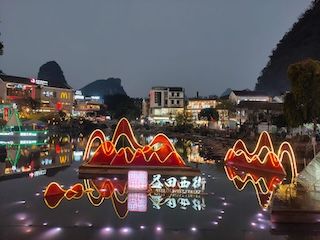
Because I was there in the off season, it was not crowded. I have read that West Street gets packed in summer, shoulder to shoulder, hard to move. In January it was busy in a comfortable way, not overwhelming. I could walk at my own pace, stop wherever I wanted, look at a stall without someone pushing past me.
I did not do much bar-hopping or live music. My kind of nightlife there was just walking around and watching people. Tour groups moving in small clusters. Vendors calling out to whoever looked interested. A street performer doing tricks for a small crowd of tourists with their phones out. At one point I got pulled in by the smell from a stall selling grilled skewers, even though I had already eaten. That is just how a street like this works. You do not need to be hungry to end up holding food in your hand.
Some shops blur together after a while, but a few stood out. A woman selling only dried mango from a small cart. A man doing calligraphy for tourists on the spot. West Street knows exactly what it is. It does not try to hide that it is a tourist street, and I liked that honesty about it.
Why It's Called West Street
West Street has a history that goes back well over a thousand years, but the version I actually walked was shaped mostly in the last forty or so. It got its name simply because it sits on the west side of old Yangshuo, and for a long time it was just a regular trading street, where merchants from around northern Guangxi came to do business. That changed starting in the early 1980s, when foreign backpackers began finding their way to Yangshuo, drawn in by the scenery. Some of them liked it enough to stay. They opened cafes and bars, taught English, and slowly the street picked up its nickname, "Foreigners' Street." By the 1990s, most shops along the street were being run by foreigners, and English signs became just as common as Chinese ones. It is still like that today. Locals say it is one of the biggest informal English-speaking corners in the whole country, and walking down it, hearing three or four languages within a few steps, it is easy to believe that.
The Yulong River
The bamboo rafting trip was on the Yulong River, and it was, without doubt, one of the best parts of the whole trip. I went in expecting it might be too touristy, too rushed, just a quick ride for a photo. It was not like that at all. It was calm, slow, and genuinely beautiful.
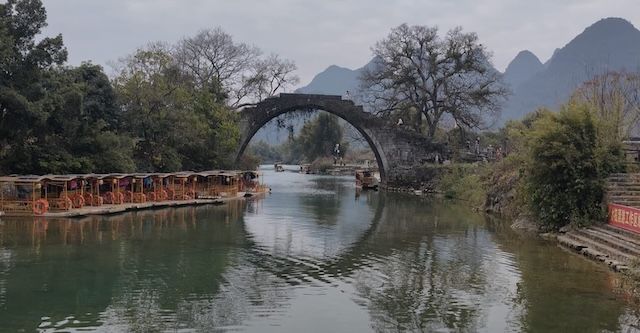
I do not remember the exact price, so I will not guess at one. What I remember is that it did not feel like a money trap, which was a nice surprise. The hills around Yangshuo have that shape you see in old Chinese paintings, tall and sudden, rising straight up from flat land. Seeing them from the water, moving slowly, with no engine sound, is very different from seeing them from a bus window. You are not passing by the view. You are inside it.
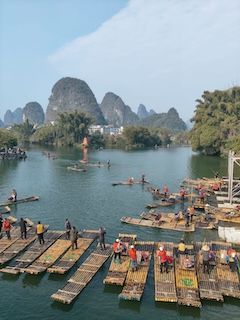 Because it was the off season, the river was quiet too. Not many other rafts around. Just me, the raft, the water, and the hills. After the first few minutes, once the newness of sitting on a bamboo raft wore off, I just settled into it and enjoyed the ride. The water was calm, almost lazy in some parts, which made the whole trip feel peaceful rather than exciting. I do not even remember feeling cold on the river. I was too busy looking around.
The Yulong River is a smaller tributary that eventually joins the Li River, and it runs through the countryside just outside Yangshuo town. Compared to the main stretch of the Li River, the Yulong is narrower, shallower, and much quieter, which is exactly why it has become the go-to river for bamboo rafting rather than large tour boats. It winds past rice paddies, small villages, and old stone bridges, with the same karst peaks lining both banks. Because the current is gentle for most of its length, rafts here move slowly enough that you can actually take in the scenery instead of just holding on.
Renting a Scooter and Just Riding
The other thing that worked really well was renting a small electric scooter and riding out into the countryside with no plan at all. If I had to pick one thing to recommend to anyone visiting Yangshuo, it would be this.
Renting the scooter was easy. No long process, no confusing paperwork, no battery problems. The only hard part was deciding which direction to go, since there was no real map to follow and no fixed place I was trying to reach.
So I just rode. Past rice fields, on narrow roads that felt built for scooters and bicycles, not cars. The same tall hills from the river now stood around the fields instead of the water. Riding slowly like this let me stop whenever something caught my eye, a bend in the road, a hill that looked slightly different from the last one. Nobody to answer to, nobody watching the time.
I passed farmers working in the fields, though I could not tell you exactly what they were doing. I passed water buffalo standing in the mud, completely unbothered by me riding past. At one point the road got so narrow I had to stop and let a three-wheeled cart pass first. The driver gave me a look, not unfriendly, just the kind of look locals give a tourist clearly out of place on a road built for daily life, not sightseeing.
I never reached any named place. No famous viewpoint, no specific village I can point to on a map now. It was just riding for the sake of riding. The wind was sharp at times, and I was glad every time I stopped and it stopped too. But after weeks of cold weather already, this cold did not slow me down.
I later read that many people rent scooters to reach Moon Hill or other named spots outside town, one of the region's most photographed karst formations, with a large natural arch worn straight through the rock. I did not go there, or if I passed it, I did not notice. My ride was simpler than that. Just fields, hills, cold wind, and a scooter with enough battery to keep going.
The Food
I ate local food most of the time, instead of the Western options that West Street also offers for tired travelers who want something familiar. I remember trying beer fish, which is a dish this whole region seems proud of river fish cooked with local beer, tomatoes, and chili. It sounds like an odd mix, but it works, somehow rich and a little sweet at the same time. It came to the table still in the pan it was cooked in, which made eating it slower and a bit messier than I expected.
I also had the local rice noodles, the Guilin style, which people from the area take very seriously. Cheap, quick, and good, the kind of meal you can order just by pointing, which helped a lot since English was hard to find anywhere outside the bigger hotels.
Honestly, the food in Yangshuo was some of the best I had on the whole trip, even though I cannot remember every dish by name now. There was a freshness to it that felt different from the food in Beijing or Xi'an, probably because so much of it comes straight from the river and the fields around town rather than from further away. Small places, plastic stools, a menu I could barely read, and food that turned out better than anywhere fancier I had eaten on the trip so far. Eating alone has its own small challenges. You either order too much and deal with leftovers, or order too little and stay a bit hungry. I am not sure which mistake I made more, only that I made one of them again and again.
Beer Fish
Beer fish is supposed to have started by accident, sometime in the 1980s, right around when Yangshuo was first opening up to outside visitors. The story goes that a local driver was cooking river fish in a pan when it started to burn, and without really thinking, he poured a bottle of beer over it to save the dish. Everyone standing around assumed it was ruined. Instead, it turned out surprisingly good, and the recipe spread from there. Today it is usually made with carp caught from the Li or Yulong rivers, fried first, then cooked down with a whole bottle of local beer along with tomatoes, chili, and garlic, until the sauce turns thick and glossy. It is served whole, skin and all, straight in the pan or on a large shared plate. Locals in the area consider it the signature dish of Yangshuo, and after having it once, I understood why people keep bringing it up.
What Made This Trip Special
Looking back, Yangshuo stands out as one of the best unplanned parts of my whole China trip. I did not research it much before going. I found very little information online. I just showed up and figured it out as I went, and that turned into one of the most memorable stretches of the whole journey.
The rough hour outside Guilin station is the only real complaint I have. Everything else, the river, the scooter ride, the evenings by the Li River, West Street at night, was better than I expected, and I did not expect much going in, since I barely knew what to expect at all.
Traveling in the off season made a real difference here. Fewer tourists everywhere I went, more space to actually enjoy things instead of fighting through crowds. I already prefer traveling this way, and Yangshuo in January was a good example of why.
There is also something about a landscape this old and this strange-looking that makes a place stick with you longer than usual. Karst peaks like these do not exist in most parts of the world, and once you have walked, ridden, and floated through a place full of them, ordinary flat countryside looks a little plain afterward.
I think part of why Yangshuo worked so well for me is that I did not treat it like a checklist. I did not wake up each day with a fixed plan of sights to tick off. I let the river trip happen when it happened, let the scooter ride go wherever it went, let the evenings by the water be as short or as long as they felt right. Compared to Beijing and Xi'an, where I was moving between big, well-known sites on a fairly tight schedule, Yangshuo was slower on purpose. Looking back, that slowness is probably the actual reason it stayed with me the way it did. Big cities give you monuments. A place like Yangshuo gives you time, and I did not fully appreciate how rare that felt until I was already on the train out.
Leaving for Shenzhen
I left Yangshuo by high-speed train, from Yangshuo Railway Station, heading to Shenzhen. It was strange, going from the quiet hills and the slow river to a big modern city. But that contrast is part of what made Yangshuo feel so special in my memory. It was the calm middle of a trip that had a lot of big cities on either side of it.
A Few Practical Notes
Some general information, separate from my own story above.
Yangshuo is close to Guilin, and most travelers reach it the way I did, fly or take a train into Guilin, then continue by bus or shared van from Guilin West Railway Station. English can be limited at the travel agents outside the station, so it helps to have your destination and transport choice written down beforehand.
West Street, officially called Yangshuo Pedestrian Street, is the main tourist and nightlife area in town. It is fully pedestrian for most of its length, so staying nearby makes it easy to walk everywhere. It has kept a mostly bilingual character since the 1980s, so even with limited Chinese, this stretch of town is easier to navigate than most.
Bamboo rafting is offered on more than one river here, most commonly the Li River and the Yulong River. Prices and trip lengths vary. The Yulong River tends to be quieter and calmer than the busier parts of the Li River, so it is worth checking which river a tour actually covers before booking.
Renting a scooter or e-bike is common and aimed at tourists who want to explore the countryside on their own. Some rental shops ask for ID or a deposit, and it is worth checking if an international license is needed, since rules can vary.
Weather changes a lot by season. Guangxi is generally warm and humid for most of the year, but winter can bring real cold, especially with wind. January also tends to be quieter for tourism here, with fewer crowds at the main spots and shorter waits for things like river trips.
Yangshuo also has its own railway station with high-speed train connections onward to cities like Shenzhen and Guangzhou, which made it easy to continue the trip without heading back through Guilin.
Would I Go Back
Yes, without question. Yangshuo turned out to be one of the best parts of my first trip to China, and I barely knew anything about it before I arrived. The quiet evenings by the Li River, the ride on the Yulong River, the scooter trip through the rice fields, all of it added up to something better than any of the more famous stops on the trip. Next time I would stay longer. Next time I might even try to find that same kind of quiet, unplanned place again, somewhere I know just as little about going in.